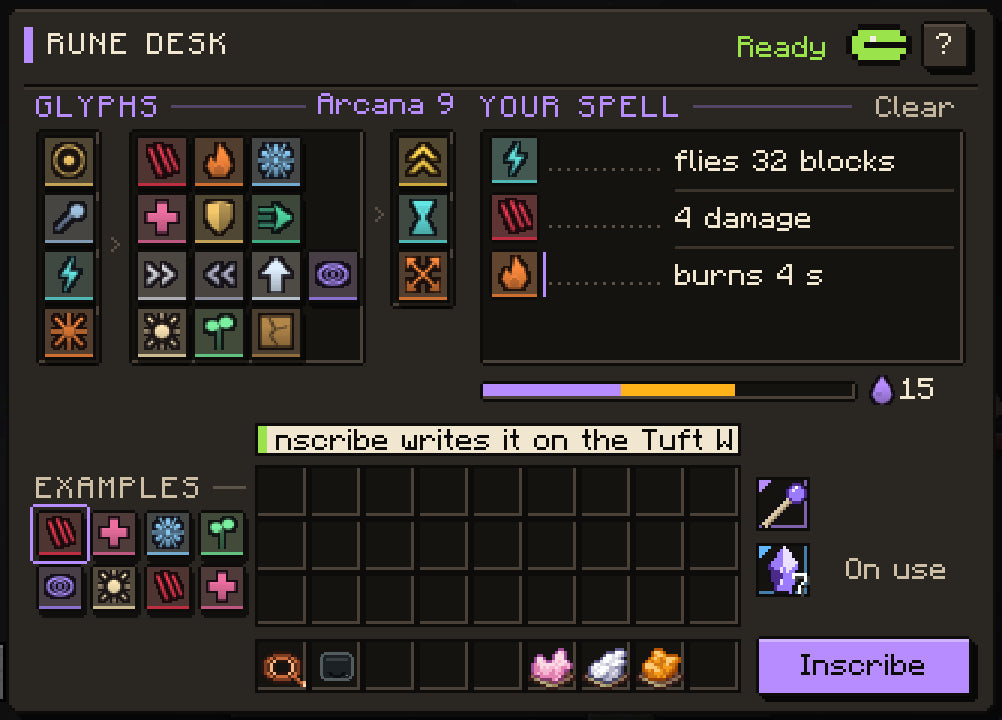
Write spells from glyphs, practise a school, and learn how its effects interact with the place around you. Magic uses tuft, while its schools add their own practices, reagents, and consequences.
Hard Hoof: Magic is its own module with 16 schools, a Rune Desk and a Grimoire. The 0.6.0 download has the schools, ranks, the Rune Desk, Tuft Wands, Spell Scrolls and imbued rings, amulets and weapons. Parts marked Not out yet are in the development build only: discovery, the notched wand and its spell wheel, imbued armour and belts, and Magic Sight. Check the Rune Desk and field guide in your installed build.
Where to start
| Need | Open or build |
|---|---|
| Write and modify spells | Rune Desk |
| See your schools, ranks, and next marks | H → Magic, the Grimoire |
| Read a first working example | H → Documentation → Magic |
| Understand an active condition | H → Conditions |
| Find ore without a sample | H → Sight (see Magic Sight) |
| Find crafting ingredients and alternatives | JEI |
Tuft
Tuft is the violet resource bar above your food. It refills over time. Focus, the Arcanist trade, worn equipment, and Arcana can affect your available tuft; see Character growth.
Casting pays the spell's cost. Writing the spell onto an item uses a Tuft Shard, a separate ingredient. Shards can come from leveled mobs or be crafted from amethyst, lapis, and redstone, so a monster drop is not your only starting route.
Your first spell
Try the desk's Firebolt example:
- Craft a Rune Desk and a Tuft Wand using JEI.
- Put the wand and one Tuft Shard in the desk's labeled slots.
- Choose Firebolt in Examples. Read its description and tuft cost.
- Click Inscribe when the desk says it is ready.
- Hold the wand and right-click to cast toward a suitable target.
Firebolt combines Bolt → Harm → Kindle. Once that works, change one glyph in an example and read how the result and cost change. You can load a spell already on an item back into the desk to edit it.
Writing spells
| Part | Job | Examples |
|---|---|---|
| Form | Select how the spell reaches a target | Self, Touch, Bolt, Burst, Thread |
| Effect | Describe what happens | Harm, Heal, Kindle, Freeze, Gust |
| Augment | Modify the relevant form or effect | Amplify, Extend, Widen |
A spell starts with one form and needs an effect. The desk allows up to eight glyphs and two schools in a spell. Common-tongue glyphs such as Harm, Heal, Light, and Shield do not count as an additional school.
The desk explains invalid combinations. Effects that undo one another, such as Freeze and Kindle, cannot share a spell. Hatched or unavailable glyphs show the requirement you are missing; drafting a spell does not mean you can inscribe it yet.
The sixteen schools
Four families of four. Their depth and requirements differ. Use the Grimoire and the school-specific field-guide entries for your next working step.
| Family | School | Focus and first direction |
|---|---|---|
| Elements | Earth | Move and sense earth; try Pitfall or a Standing Stone. |
| Elements | Water | Draw, soak, and surge; try Water Whip or a Rain Basin. |
| Elements | Fire | Move heat, kindle, freeze, and smelt; start with Firebolt or a Hearth. |
| Elements | Air | Move air and work with breathing or pressure; try Updraft or a Weathervane. |
| Fabric | Space | Fold distance; begin with Blink. |
| Fabric | Time | Borrow time with a later repayment; begin with a Quicken spell. |
| Fabric | Void | Hold and release; try the Hold or build a Void Well. |
| Fabric | Electric | Move charge; try Jump Start or a Storm Jar. |
| Life and Death | Divine | Offerings, favour, vows, and blessings; begin at a shrine. |
| Life and Death | Necromancy | Read remains and temporarily raise creatures; try Ask the Dead or an Ossuary. |
| Life and Death | Pestilence | Work with survived strains, samples, and cultures; inspect the Culture Jar and strain recipes. |
| Life and Death | Witchery | Herbs, brews, and a garden's Bloom; try Verdant Burst or a Kettle. |
| Minds and the Outside | Mind | Nerve, company, and influence; a lit campfire or bonding with a creature starts practice. |
| Minds and the Outside | Oneiromancy | Dreams and sleeping minds; sleep after time awake and hang a Sleep Loom over the bed. |
| Minds and the Outside | Xenomancy | Summons and readable pact terms; start with an Emberkin seal and Call. |
| Minds and the Outside | Eldritch | Insight and unusual perception; build a Listening Stone and listen in the dark. |
Practice and progression
The Grimoire tracks each school's nine ranks, practice, and marks. Casting a school's glyphs and using its practice grows that school. Ranks rise by themselves, but a full practice bar can still wait on a mark: read the Grimoire's next-step text.
| Rank | Mark | How you reach it |
|---|---|---|
| 1 | Met | Cast its scroll, use its item, or be hit by it |
| 4 | Practised | Finish the practice's first working example |
| 7 | Attuned | The attuning rite at the school's practice |
A first reagent and an attuning rite matter alongside practice. For example, the elemental practices produce Ember, Deep Grit, Spring Salt, and Still Feathers. JEI shows their related recipes; the Magic field guide explains the practices.
From rank 4, a school holds weight, and weight in your other schools slows the one you practise. Resting a school at its practice halves its weight, and its tier III glyphs sleep meanwhile. Nothing is ever closed to you; it only gets slower. The Grimoire shows your weight, breadth and pace, and a toast says what each new rank costs.
Place changes the result
The desk's PLACE information explains environmental costs. Heat, pressure, mass, distance, and available material can change what a spell can do or how much it costs. A large freeze in warm surroundings can cost far more than a small effect near a cold sink.
Electric magic can put energy into storage, but accumulated Static limits sustained use. Time effects have repayment. Read the spell's actual cost and condition effects instead of assuming magic provides unlimited factory power.
Magic you discover
Not out yet. Every effect glyph does what its card says. On top of that, magic has a hidden machine you learn by experiment: start messy, then stumble into something you earned.
Aspects
Every effect leans along six axes, each a pair of opposites:
| Axis | One side | Other side |
|---|---|---|
| Temperature | Heat | Cold |
| Motion | Push | Pull |
| Life | Life | Death |
| Tempo | Quick | Still |
| Form | Solid | Hollow |
| Spirit | Calm | Dread |
Kindle leans Heat, and a little Death: fire consumes. Gust leans Push, and a little Cold: wind cools. A spell's lean is the sum of its effects, and an augment scales the effect before it. The desk shows each glyph's aspects as ? until you have learned them.
Backlash
What a spell leans, the world leans back. The first point of lean on an axis is free. Past that, you feel it:
| Lean | Backlash |
|---|---|
| Heat | Your hands burn |
| Cold | Frost and slowness |
| Push | You are thrown back |
| Pull | You are dragged forward |
| Life | Hunger |
| Death | Damage, never below one heart |
| Quick | Nausea |
| Still | Slowness |
| Solid | Mining fatigue |
| Hollow | Weakness |
| Calm | Darkness |
| Dread | Lost Nerve |
Opposites cancel inside one spell. Heal alone makes you hungry; Heal with a Death-leaning effect does not. Two Heat glyphs burn twice as hard. Backlash never kills, no resistance softens it, and a ring's own trigger kicks half as hard. Creative players feel none. The game rule magic_backlash turns it off for a server.
Grasp
You have a grasp of each glyph, 0 to 100%. It rises each cast, by 4.5% of what is left, three times that for a sentence you have never cast, and a little more when you felt backlash. Grasp holds the kick back: a new glyph is messy, and the same glyph a hundred casts later is clean, at best 70% held back.
An aspect is learned when you feel backlash on it, when your grasp of its glyph reaches 50%, or when you cast it while Star-Touched (Eldritch's Glimpse, which shows every glyph's aspects in the spells you cast). The second lean of each glyph is the part theory-crafters hunt.
Resonances and findings
Some patterns of aspects resonate. When a spell's summed aspects meet a pattern, and at least two different effects push it there, something more goes off on top of the spell, and the kick on those axes is spent in it. The first time, it becomes a finding in the Grimoire's new FINDINGS tab, with its name and its pattern.
A resonance is about aspects, not glyphs: once you know a pattern, any glyphs that reach it make it. Once you grasp each glyph in a sentence to 30%, the Rune Desk tells you when it hums (it meets a resonance you have not found) or hums faintly (one point short). Casting a sentence you have never cast gives each of its schools practice, and a finding gives more.
Spoilers: the fourteen findings are Heartwood, Frostbind, Thunderclap, Undertow, Wildfire, Second Wind, Stoneskin, Rot, Panic, Hearthglow, Slipstep, Quake, Hush and Eclipse. Their patterns and routes are not listed here. Finding them is the point.
Imbuing
| Write on | How it triggers |
|---|---|
| Tuft Wand | Right-click to cast its stored spell |
| Paper | Produces a single-use Spell Scroll |
| Ring, amulet, belt or armour | When hurt, or every five seconds while worn, according to the chosen trigger |
| Weapon | When it hits |
Armour and belts are Not out yet. Imbued effects still pay tuft. Several automatic effects can exhaust the same reserve. Use the desk's trigger selector and read the item's tooltip before wearing or using it. A worn piece carries one spell. For rings, amulets and belts to wear, see Rings, amulets & gear.
The notched wand and the spell wheel
Not out yet. In 0.6.0 a Tuft Wand holds one spell. In the development build it holds up to eight in notches.
- How many you can use is yours, not the wand's: 3, one more every 10 Arcana, and one more for an Arcanist. A traded wand keeps every spell. Notches past your count are locked and never lost.
- Switch with Sneak + scroll, or hold B (Spell wheel) to open a wheel of your notches and let go on the one you want. A click, a number key or Enter picks too.
- Each spell keeps its own cooldown of half a second, so switching never resets one. After a switch the wand settles for 0.4 seconds before it casts.
- A chip above the hotbar shows the picked notch's number, its school, its name and its cost.
- At the Rune Desk, a row of notch tabs appears with a wand on it. Inscribe writes into the picked notch, Erase clears only it, and Load reads it.
A wand written before notches reads its one spell as notch 1.
Oneiromancy's Thread
Not out yet. The Thread reaches a mind you are linked to, up to 256 blocks away in the same world, at double tuft. It used to carry only Send, Heal, Soothe and Hex. Now it carries any effect once your Oneiromancy rank allows it: helpful effects from rank 4 (Practised), harmful ones from rank 7 (Attuned). Harmful ones still pass only where PvP and teams allow. You can Shield a teammate across the valley, or chain another school through the dream-link.
Three useful side projects
- Settling Tea: turn a cauldron over a lit campfire into a Kettle, use water plus soothing and sweet herbs, then bottle the brewed tea. JEI lists plants by virtue, so you can choose available ingredients.
- Dream Thread: place a Sleep Loom within three blocks above a bed and sleep after enough time awake. Read the Dreams guide for rest, dreams, and lucid dreaming.
- A summoned companion: Creatures distinguishes temporary raised undead, fighting pact beings, and non-fighting familiars. Read the pact's upkeep and term before summoning.
If a spell fails
Read the message first: not enough tuft, a missing shard, a school or Arcana requirement, an incompatible trigger, and an invalid target are different problems. At the desk, hover the blocked glyph or status. For ongoing effects, open Conditions to see the cause and ways to end them.