Module: Hard Hoof: Tech (hardhoof_tech)
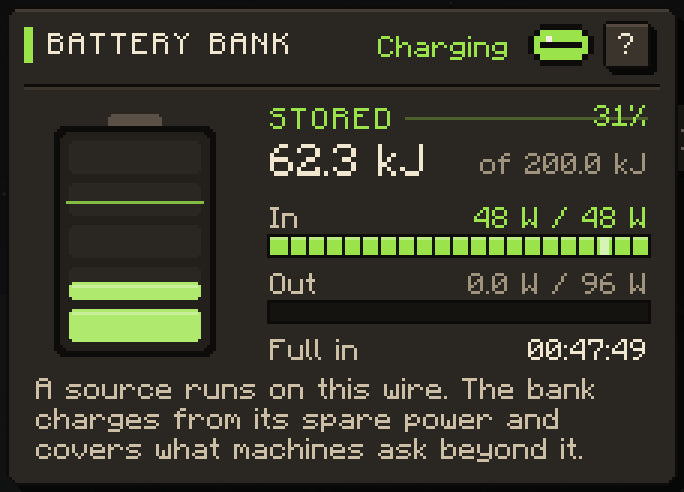
The Battery Bank stores charge for a 24 V DC wire network. It fills from the power a source has spare, and gives it back when machines ask for more than the source makes, or when no source runs at all. Build it in the Machine Workshop.
Workshop recipe
New in the development build. A Battery Bank takes a Hearth Casing, one of two ingredient sets:
| Route | Ingredients | Makes |
|---|---|---|
| Capacitors | 2 capacitors, 1 Copper Contacts, 2 blocks of redstone | 1 |
| Battery Cells | 2 Lead-Acid Battery Cells, 1 Copper Contacts | 2 |
Result: hardhoof_tech:battery_bank_1. The capacitor route is for early play. Once you have lead and sulfuric acid, two Lead-Acid Battery Cells (made at the Workshop from lead ingots, sulfuric acid and iron plates) make two banks at once. See Tech tiers for casings and parts. The 0.6.0 download uses an older pattern; JEI shows your build's recipe.
Storage and ratings
| Quantity | Value |
|---|---|
| Stored charge | 200 kJ |
| Charging | up to 2 A at 24 V (48 W) |
| Supplying | up to 4 A at 24 V (96 W) |
| Full to empty at 96 W | about 35 minutes |
| Empty to full at 48 W | about 69 minutes |
Away from home. A Battery Bank keeps working exactly as if you had stayed when its chunk unloads.
Charge is real energy. It only comes from a source's spare current, and it only goes to machines: banks never charge each other. A broken bank keeps its charge on the item, and the item's tooltip says how much.
How it shares a wire
- With a running source (Coal Generator, Steam Turbine): the source drives the wire. Machines take the source's current first. If they want more, every bank on the wire covers the rest, each in proportion to what it can give. Any current the source has left over charges the banks.
- With no running source: the banks drive the wire themselves. The bank with the lowest position delivers, and all banks on the wire share the load.
Several generators on one wire still elect one owner and do not add up. Banks are the way to add capacity to a wire.
Controls and connections
Wire it on any face. No slots and no side settings. The front shows the charge in fifths (the last fifth is amber) and a lamp and arrow: jade pointing up while charging, sky blue pointing down while supplying.
The screen shows the stored charge, power in and out against their limits, and how long until it is full or empty at the current rate. The status chip explains what it is doing. Jade shows power, status and stored joules.
Programs see it as a device: dev battery_bank status returns {status, stored_j, capacity_j, percent, watts_in, watts_out, wire}.
First example
- Place a Coal Generator and a Battery Bank. Run copper wire between them and on to an Electric Furnace.
- Fuel the generator. With the furnace idle, the bank charges at 48 W (jade lamp, cells filling).
- Let the generator run out of coal. The bank takes over, and the furnace keeps smelting on the bank's charge (sky lamp).
Common failures
- No wire: the status chip says so. Connect copper wire to any side.
- Idle, never charging: the source's whole output goes to machines. Add a source, or cut the load.
- Empty: no source has run on this wire since the bank drained.
- Supplies less than 96 W: wire gauge, cable resistance and its remaining charge cap the current. A nearly empty bank only gives what it can pay for.