New
Module: Hard Hoof: Tech (hardhoof_tech), with worlds made by Hard Hoof: Portals (hardhoof_portals)
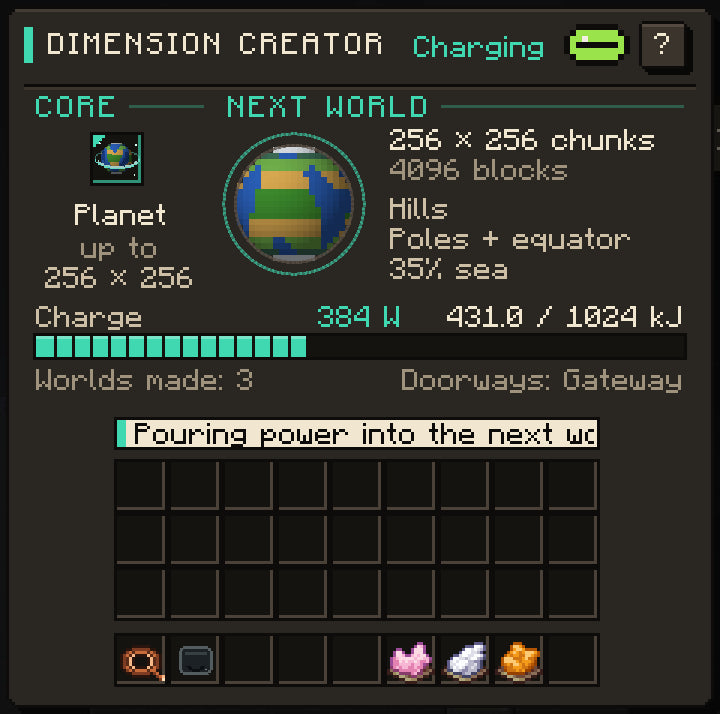
The Dimension Creator is the worlds reality device. It makes a whole new world of a set size, terrain and climate. The World Core in its slot sets the largest world it can make: from a single chunk up to a 256-chunk planet with cold poles and a hot equator. A Gateway opens the doorway into a made world. Build both in the Machine Workshop.
Like the other reality devices, it has no controls of its own. A Terminal drives it with the worlds command or the Worlds app.
Workshop recipes
Changed in the development build. The Dimension Creator and the Gateway are now Atomic machines: each starts from an Atomic Casing (4 steel ingots, 4 lead ingots, 1 uranium ingot, made at the Workshop) and takes Silver Contacts (4 silver ingots and 1 redstone make 4). See Tech tiers. The 0.6.0 download uses older plate-and-wire patterns for both; use JEI for exactly what your build asks.
Dimension Creator (5 × 3 surface; the layout is in JEI):
| Ingredient | Count |
|---|---|
| Atomic Casing | 1 |
| Logic Board | 2 |
| Silver Contacts | 2 |
| Eye of Ender | 1 |
| Obsidian | 4 |
No Nether trip needed: a second recipe swaps the Eye of Ender for 1 Ender Pearl and 2 Amethyst Shards. The rest is the same.
World Cores. Each core after the first is crafted from the one before, so worlds grow one step at a time.
| Core | Largest world | Recipe (3 × 3) |
|---|---|---|
| Pocket Core | 1 × 1 chunks (16 blocks) | 4 Glass, 4 #c:gems/quartz, 1 Ender Pearl |
| Garden Core | 4 × 4 chunks (64 blocks) | 2 Logic Board, 4 Moss Block, Pocket Core |
| Island Core | 16 × 16 chunks (256 blocks) | 4 Transistor, 3 Prismarine Shard or Nautilus Shell, 1 Microcontroller 1K, Garden Core |
| Continent Core | 64 × 64 chunks (1024 blocks) | 4 Diamond, 2 Chipset CPU, 2 Amethyst Shard, Island Core |
| Planet Core | 256 × 256 chunks (4096 blocks) | 4 Memory Module 256K, 2 Chipset CPU, Nether Star or Block of Diamond, Heart of the Sea or Nautilus Shell, Continent Core |
A core is not used up. It stays in the machine and can be swapped at any time.
Power and cost
| Quantity | Value |
|---|---|
| Cost of a world | 4 kJ for every chunk across |
| Pocket world (1 chunk) | 4 kJ |
| Planet (256 chunks) | 1.024 MJ |
| Charging rate | up to 384 W (a gauge 4 wire's full load at 24 V) |
| Store | 20 kJ, filled from DC power at the back |
| Planet at full rate | about 44 minutes |
The creator fills its store from the cable and pours up to 384 W from it into the world it is charging, so a small supply still makes steady progress. Cancelling keeps the charge for the next world. When the charge is full, the world is made.
Worlds
Every world is a square tile of the planned size, and it loops. Walk off the east edge and you come back at the west; go north past the pole and you come up from the south. What you build near one edge shows past the other, and a one-chunk world is the same chunk in every direction.
Still rough at the edges:
- Animals, items and other players just past an edge show up once you cross.
- Light does not spread across an edge, so a torch right at the edge lights only its own side.
- Structures (on the Hard Hoof Planet world type) can be cut where they meet an edge.
| Setting | Values |
|---|---|
| Size | 1 to the core's largest, in chunks across |
| Terrain | flat, plains, hills, mountains, islands |
| Climate | planet, frozen, cold, temperate, warm, hot |
| Sea | 0 to 95 percent of the surface |
| Seed | 0 to 999,999,999; the same seed makes the same world in the same save |
With the planet climate, the north and south edges are frozen and the middle row is the equator. Between them lie taiga and temperate forest, deserts near 30 degrees and jungle near the equator, and high ground is colder. Rivers, caves, ores, trees, plants and animals come from the vanilla biomes. Villages and other structures are not generated.
Controls and connections
- Back: DC power.
- Slot: one World Core.
The screen shows the core, the next world as a turning globe with its size, terrain, climate and sea, and the charge. It has no buttons.
On a Terminal next to it, or joined to it by a Data Cable:
| Command | What it does |
|---|---|
worlds |
the plan, the charge and the doorway |
worlds size 16 |
chunks across (also terrain, climate, ocean, seed, name) |
worlds make |
start charging |
worlds watch |
show the charge until the world is made, then point a Gateway at it |
worlds cancel |
stop charging |
worlds list |
the worlds this creator made |
worlds open 2 |
lead the Gateway's doorway to world 2 |
worlds close |
close the Gateway's doorway |
The Worlds app shows the planned world's map before it is made, with buttons for every setting, and lists made worlds with Open buttons for the Gateway. Programs see the creator as a device: dev dimension_creator status, set, preview, make, cancel, worlds.
Gateway
The Gateway holds a seamless doorway open to any made world: the far world shows through it, and walking in needs no loading screen. Placing it builds its own frame, a 5 × 5 ring of Gateway Frame blocks with the Gateway in the middle of the bottom row, around a 3 × 3 opening. The whole 5 × 5 square must be free, or placing refuses and names the block in the way.
Gateway, in the development build (layout in JEI):
| Ingredient | Count |
|---|---|
| Atomic Casing | 1 |
| Logic Board | 1 |
| Silver Contacts | 2 |
| Ender Pearl | 2 |
| Quantity | Value |
|---|---|
| Opening the doorway | 10 kJ from its store |
| Holding it open | 12 W |
| Store | 20 kJ, filled from DC power at its bottom or back |
- Bottom and back: DC power. Any face: a Data Cable.
- The far end of the doorway stands in a matching frame on a smooth stone pad at the world's arrival point.
- When the power fails, the doorway stays open while anyone is on the far side, then closes; it opens again by itself when power returns.
- Breaking any frame block takes the whole Gateway down, and it drops as one item.
On a Terminal: gate (its state), gate list (every made world), gate open 1, gate close. Programs: dev gateway status, worlds, open, close.
First example
- Put a Pocket Core in a Dimension Creator and wire DC power to its back.
- Place a Gateway facing you with a free 5 × 5 square around it, and wire DC power to its bottom or back.
- Join both to a Terminal (touching it, or by Data Cable) and type
worlds make, thenworlds watch. - When the world is made, the Gateway leads there and opens. Walk through it. Turn round to come back.
Common failures
| Status | Cause |
|---|---|
| No core | The slot is empty. |
| No power | It is charging but has nothing to pour. Wire DC power to its back. |
| Stopped | Something stopped it. worlds on a Terminal says why. |
| Gateway: Blocked | Something stands in the opening, or the world is missing. It retries every few seconds; gate says why. |
| Gateway: Frame broken | A frame block is gone. Place the Gateway again. |
Breaking the creator drops its core. The worlds it made remain.
Hard Hoof Planet world type
The same planets are also a world type, and new worlds start as one: the Overworld itself is a planet of five named continents, 256 chunks (4096 blocks) across, 55% sea, with villages, strongholds and the other vanilla structures. Customize chooses a style, size and shape, continents, sea, land, climate, biome size, rivers, caves and structures, and shows the map of the world you will get. Press M on any planet for its world map. The Nether and the End are vanilla. On a dedicated server, set level-type=hardhoof_portals:planet. The full guide: Hard Hoof Planet.